|
Derek has a son, John, who has served in the Territorial Army Unit, Ten Para. in 2008 one of John's Army friends was telling him the story of an engagement in Afghanistan and said how much he would like to have a painting which would capture the drama of that particular moment. John immediately volunteered his Dad. it took Derek some time to agree to venture into this unfamiliar subject matter but in fact that painting, The Hammer, was to be one of several scenes of combat which he would paint in the next eighteen years, each one requiring hours of preliminary research into positions, weapons and uniform, and all of them pro bono.
|
Below: The Hammer
oil on board, 54 inches x 72 inches, 2012 British troops engage with the Taliban at Scaramanga AO, Helmund Province, Afghanistan, 2008. Commissioned in memory of all who fought that summer, by Nick Myers, Adjutant of 2 Para, in 2011. Now hanging in Colchester Barracks |
Below: North Africa, 1943, The Battle of Tamera
From an original oil painting (54 x 72 inches) by Derek Chambers
Commissioned by Lt.Col.Duncan Mann 2 Para Co February 2016 - August 2018, to mark the 75th anniversary of the battle
Between the 7th and the 29th March 1943, on land near the village of Tamera, the 1st Parachute Brigade inflicted a decisive defeat on the Axis forces in Tunisia. This battle brought to an end five months of fighting in North Africa, during which the 1st Parachute Brigade suffered 1,700 casualties, took over 3,500 prisoners and inflicted over 5,000 casualties on the enemy. In the course of the operation, the German soldiers came to admire the fighting ability of the paratroopers, christening them "Rote Teufel" - Red Devils. Such was the standing of the paratroops in enemy eyes that on the journey away from Tamera, as the train carrying the Brigade slowly passed a prisoner-of-war camp, the inmates, catching sight of the red berets, ran from their tents to cheer their former adversaries. As Commander 18th Army Group, General Alexander, stated in his congratulations to the Brigade: "Such distinctions are seldom given in war and then only to the finest fighting troops”.
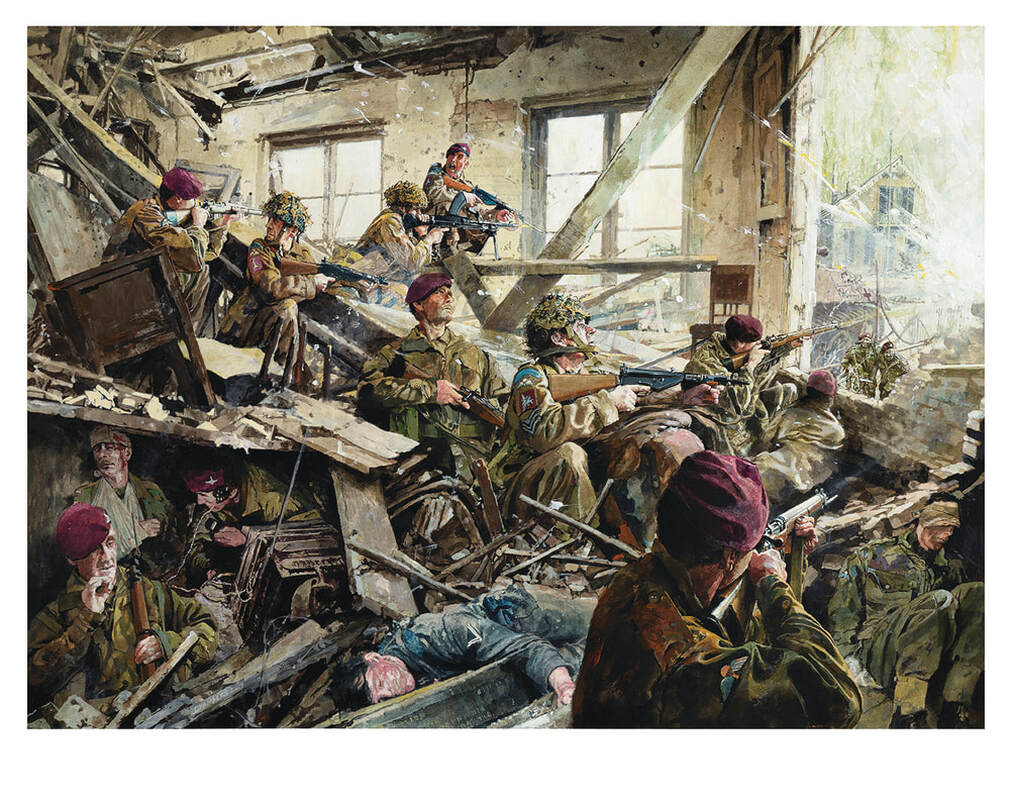
Below: The Last Stand of the 10th
The Oosterbeek Perimeter, Battle of Arnhem, September 1944
Acrylic on Board 22 x 30 inches
The Oosterbeek Perimeter, Battle of Arnhem, September 1944
Acrylic on Board 22 x 30 inches
n 2018 Derek was asked if he would produce a piece of work to commemorate the part played by the 10th Battalion of the Parachute Regiment in the Battle of Arnhem. Five hundred and eighty-two paratroopers of the Battalion landed in Holland on the 18th September 1944 as part of a large Allied invasion force, code-named Operation Market Garden, intended to secure the northern approach to bridges over the Rhine.
There was unexpected resistance and the air-borne British troops were met by an overwhelming force of German soldiers. Intense fighting broke out and by the afternoon of the 20th September the Battalion was reduced to a fighting unit of a handful of officers and fifty-eight NCOs and other ranks, while another forty 10th Battalion troops were dispersed among other units.
The painting depicts a scene from the houses defended for three days by this core unit of the Tenth, two hundred yards ahead of the perimeter which had been established by the main 1st Airborne Division. They held this position for three days, fighting from house to house with only small arms, mines and mortars against heavy enemy opposition including armoured tanks, as the buildings were systematically destroyed and their numbers reduced.
On 23rd September, with all their officers either dead or wounded, the remaining men of the Tenth were relieved and withdrawn into the perimeter to join other mixed Airborne units.
After the battle, only thirty-six men of the Tenth returned to their base at Somerby in Leicestershire, followed a few days later by a further fifty survivors. As a result of these losses, the 10th Battalion was never reformed. The survivors were absorbed into the 2nd Battalion, who had incurred equally severe losses.
The heroic and ultimately disastrous Battle of Arnhem is still gratefully remembered and commemorated annually in the Dutch town where so many Allied troops lost their lives.
This painting was donated by Derek Chambers to the charity, Friends of the Tenth. The sale of signed prints raised over £30,000 towards the cost of the memorial to the Tenth which was erected in Somerby in 2019. The original was sold and subsequently donated to the Imperial War Museum at Duxford
(Based on a synopsis by Grahame Warner, historian of the Tenth.)
There was unexpected resistance and the air-borne British troops were met by an overwhelming force of German soldiers. Intense fighting broke out and by the afternoon of the 20th September the Battalion was reduced to a fighting unit of a handful of officers and fifty-eight NCOs and other ranks, while another forty 10th Battalion troops were dispersed among other units.
The painting depicts a scene from the houses defended for three days by this core unit of the Tenth, two hundred yards ahead of the perimeter which had been established by the main 1st Airborne Division. They held this position for three days, fighting from house to house with only small arms, mines and mortars against heavy enemy opposition including armoured tanks, as the buildings were systematically destroyed and their numbers reduced.
On 23rd September, with all their officers either dead or wounded, the remaining men of the Tenth were relieved and withdrawn into the perimeter to join other mixed Airborne units.
After the battle, only thirty-six men of the Tenth returned to their base at Somerby in Leicestershire, followed a few days later by a further fifty survivors. As a result of these losses, the 10th Battalion was never reformed. The survivors were absorbed into the 2nd Battalion, who had incurred equally severe losses.
The heroic and ultimately disastrous Battle of Arnhem is still gratefully remembered and commemorated annually in the Dutch town where so many Allied troops lost their lives.
This painting was donated by Derek Chambers to the charity, Friends of the Tenth. The sale of signed prints raised over £30,000 towards the cost of the memorial to the Tenth which was erected in Somerby in 2019. The original was sold and subsequently donated to the Imperial War Museum at Duxford
(Based on a synopsis by Grahame Warner, historian of the Tenth.)